
Field Notes / October 2026
Finding steelhead and brown trout in the Great Lakes
At a glance
| steelhead | about 55-65 °F, top 20-40 ft |
| brown trout | about 54-63 °F |
| spring browns | 5-20 ft, warm nearshore water |
| key feature | temperature breaks |
Quick answer
Both fish are looking for a temperature. NY DEC lists steelhead at 55-65 °F (optimum 60) and brown trout at 54-63 °F (optimum 58) [1]. In spring, browns crowd the shoreline wherever the water is warmest: harbors, river mouths and warm-water discharges [1][10]. Steelhead spend much of the summer offshore, high in the water column, often 20-40 ft down over very deep water, and they gather along temperature breaks and scum lines [1][6]. Find the right temperature at the right depth, and you are most of the way there.
The problem
Surface temperature is the number most anglers have, and it is the least useful one. A boat gauge reads the top foot of water. Steelhead and browns respond to the water where your lure is, and on the Great Lakes that can be very different from the surface, and change in a day.
01
Spring browns: find the warmest water
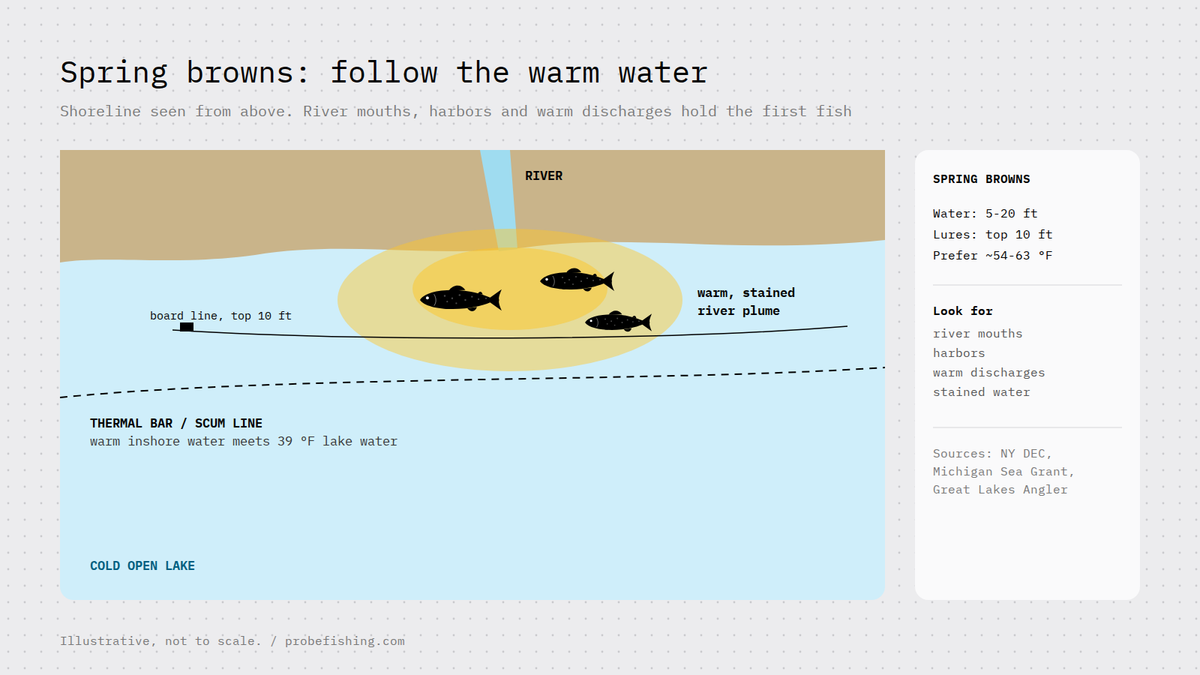
Brown trout are often the first fish to bite in spring. Michigan DNR notes that anglers troll largely inshore water early in the year, often before other species begin to bite [8]. In spring, NY DEC finds browns along much of the shoreline, near warmer water along shore or at tributary mouths [1]. Mark Romanack puts it simply: bait fish and the browns that depend on them will be in the warmest available water, and warm discharges and tributaries carrying warmer or stained water are as good as it gets [10].
That water is shallow. Captain Dan Keating fishes spring browns in 5-20 ft of water [9], and a 2024 Lake Ontario report describes trolling 5-25 ft with baits in the top 10 ft, on planer boards 75-150 ft behind the boat [11]. Stickbaits and spoons are the standard.
With PROBE →
A degree or two separates a good spring plume from an empty one. Run PROBE on a board line through the plume and out of it again: the app shows where the water was warmest, how deep your stickbait ran and where the strike came.
02
The thermal bar
In spring, the Great Lakes warm from the edges. Near shore the water heats above 39 °F (4 °C), while the open lake stays at 39 °F, the temperature at which water is densest [3][4]. Where the two meet, a band of calm water forms parallel to shore. Michigan Sea Grant explains that insects and debris collect in this convergence zone, which attracts fish, and anglers call it a scum line [3]. The bar moves farther offshore as spring goes on [3].

03
Summer steelhead: high and offshore
Steelhead tolerate warmer water than salmon or lake trout, so in summer they stay high while other species go deep. NY DEC describes rainbows fished 20-40 ft down over 300-500 ft of water, generally above the thermocline [1]. Michigan Sea Grant describes steelhead in waters less than 35 ft deep at 58-62 °F, feeding mainly at mid-depths [2]. Michigan DNR reports from Lake Michigan say the same thing in practice: spoons in the top 30 ft over 90-120 ft of water, fish caught in the top 35 ft, steelhead on the scum lines and staying high [7].
Temperature breaks are the key structure in open water. Michigan Sea Grant describes them as surface gradients of 3-10 °F, and notes that anglers report better catches at thermal fronts than away from them [2]. Upwellings, wind and current create scum lines that attract steelhead, and on Lake Michigan the offshore steelhead bite often runs from early June into July [6].
With PROBE →
On a temperature break, the difference between the warm and cold side can be a few hundred yards and a few degrees. PROBE logs the temperature where your lure actually runs, so you can see which side of the break your strikes came from.
04
Use the satellite maps
You don't have to find breaks by chance. NOAA's Great Lakes Surface Environmental Analysis (GLSEA) is a daily map of surface water temperature built from satellite data [5]. Michigan Sea Grant points anglers to these maps, updated twice daily, and suggests looking for rings of cooler water nearshore in summer and early fall [2]. One caveat: where clouds block the satellite, the map fills gaps by smoothing, so a given day may not show fresh data everywhere [5]. Use the map to choose an area, then measure on the water.
05
Summer and fall browns
As the shoreline warms, browns move off the beach. NY DEC says they move farther offshore in summer and may need to be fished down to 60 ft or more [1]; Captain Keating usually finds them in 30-50 ft [9]. Watch for upwellings: whenever cold water rolls into the beach, browns can feed in less than 10 ft of water [9]. Strong westerly winds on Lake Michigan push warm surface water offshore and pull cold water up near shore, which can bring trout and salmon back close to shore [12]. From late summer, browns stage off spawning rivers and harbors [9].
06
Speed matters, and the GPS can lie
Captain Mike Schoonveld finds that steelhead respond better to speeding up than slowing down, and starts at about 3 mph when targeting them [13]. Keating likes a fast troll for summer and fall browns, often above 2.6 mph [9]. But speed over ground is not the speed your lure feels. Schoonveld has seen surface and at-depth speed readings differ by as much as 2 mph when current is present [13], and points out that water is rarely the same temperature top to bottom or side to side [14].
Know the temperature where your lure is, not just at the surface.
See trolling mode →PROBE
How PROBE helps
Steelhead and browns are temperature hunters, so PROBE starts with temperature: it logs the water temperature at every depth your lure passes, on any line, from planer boards to divers. Trolling mode records your route and boat speed next to the lure's real running depth. Every strike is saved with depth, temperature, position and weather, so you can see which plume, which side of the break and which depth produced, and go back to it.
Field log / EXAMPLE DATA – NOT A REAL SESSION
Mid-April, Lake Ontario, river mouth in 10-20 ft of water
| Surface temp | 44 °F in the open lake, 50 °F in the river plume |
| Temp at lure depth | 48-50 °F inside the plume, 43 °F outside it |
| Lure depth (PROBE) | 6-9 ft, stickbaits on planer boards |
| Speed (GPS) | 2.3 mph |
| Location / feature | stained plume spreading east of the river mouth |
| Strikes | 5 brown trout, all inside the plume; none outside |
The plume was about 6 °F warmer than the lake around it, and every fish came from it. The board lines that drifted out of the stained water went quiet.
Field rule
Spring browns: warmest water near shore. Summer steelhead: the cool side of a break, high in the column.
FAQ
Frequently asked questions
What temperature do steelhead prefer in the Great Lakes?
NY DEC lists 55-65 °F with an optimum of 60 °F; Michigan Sea Grant describes steelhead in 58-62 °F water.
Where are brown trout in spring on the Great Lakes?
Near shore in the warmest water: harbors, river mouths and warm-water discharges, often in 5-20 ft with baits in the top 10 ft.
What is a scum line?
A band of calm water where debris collects along a temperature boundary, such as the spring thermal bar. It concentrates bait and attracts trout.
Every pass logged: depth, temperature, strike.
Get PROBE →Sources
- NY DEC, "Trolling for Lake Ontario Trout and Salmon"
- Michigan Sea Grant, "Searching for Steelhead"
- Michigan Sea Grant, "Thermal bars make appearance on Great Lakes"
- Canadian Hydrographic Service, "Water circulation in the Great Lakes"
- NOAA GLERL CoastWatch, "Lake Surface Temperature"
- Game & Fish, "Lake Michigan's Offshore Steelhead On Cue"
- Michigan DNR Weekly Fishing Report, July 24, 2014
- Michigan DNR, "Brown trout"
- Great Lakes Angler, "Brown Trout - Captain Dan Keating"
- Great Lakes Angler, "A Game Plan for Spring Brown Trout" (Mark Romanack)
- Visit Oswego County, spring brown trout report (2024)
- Illinois DNR, Lake Michigan temperature and salmonid notes
- Great Lakes Angler, "Speed Traps" (Capt. Mike Schoonveld)
- Great Lakes Angler, "Probing the Depths for Precision Fishing" (Capt. Mike Schoonveld)