
Field Notes / October 2026
The easiest way to know your trolling depth on the Great Lakes
At a glance
| downrigger | weight blows back, ~20 % at 4 mph |
| leadcore | ~5 ft per color at ~2.5 mph |
| copper | ~20-22 ft per 100 ft |
| divers | charts assume 20 lb mono |
Quick answer
Every common trolling method gives you an estimate of depth, not a measurement. Downrigger weights blow back and run shallower than the counter says [1][2]. Leadcore and copper follow rules of thumb that shift with speed [3][5]. Diver charts assume one line type and one speed [7]. The easiest reliable way to know your trolling depth is to measure it on the line itself, then use those numbers to calibrate the methods you already use.
The problem
On the Great Lakes, you are often trolling for fish holding in a band only 10-15 ft thick, 50-150 ft down. A 20 % error at 100 ft is 20 ft: enough to run the whole day above or below the fish without knowing it.
01
Downriggers: the counter is not the depth
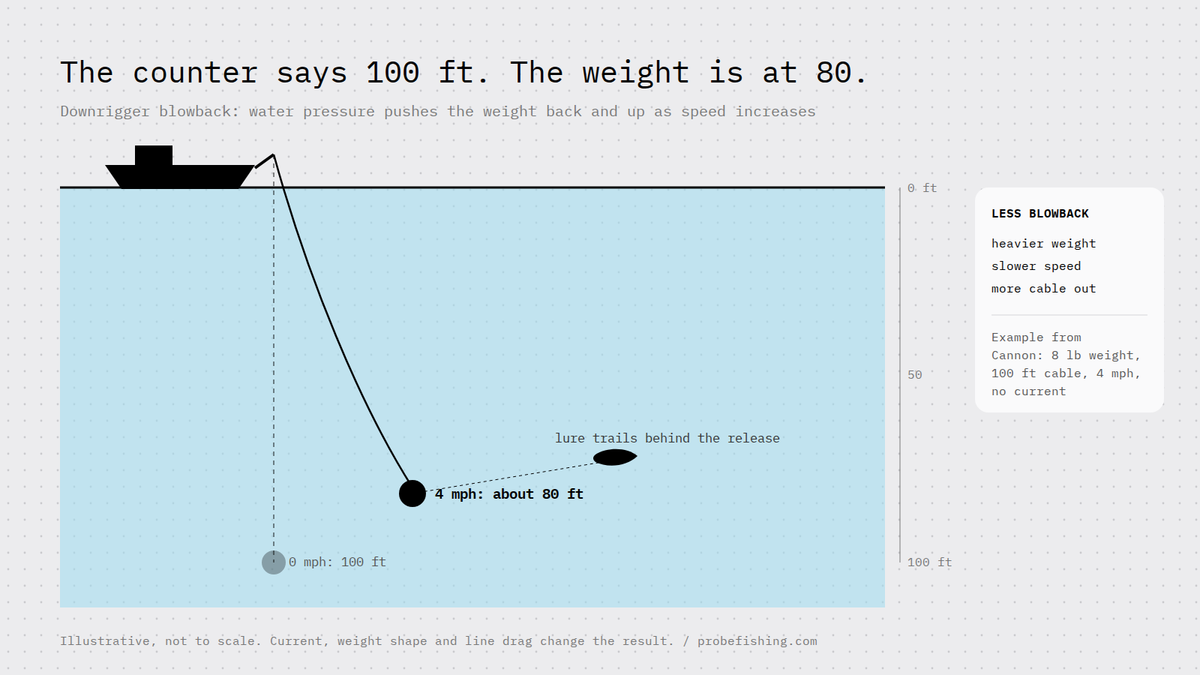
Downriggers are the most precise tool most trollers own, but the counter measures cable, not depth. Water pressure pushes the weight back and up. Cannon gives an example: at 4 mph with an 8 lb weight and 100 ft of cable out, with no current, the weight is actually about 80 ft down. Heavier weights and slower speeds reduce blowback [1]. Captain Mike Schoonveld describes the same effect: with 60 ft of cable out, the lure tracks about 55 ft deep at slow speed and about 45 ft at a fast troll [2]. And the lure doesn't run at the ball's depth either; it trails behind the release on its own line.
With PROBE →
PROBE on the fishing line, just ahead of the lure, records where the lure actually runs. Put out 60 ft of cable, troll at your normal speed and read the real depth in the app. Now you know your blowback, for your weight, your speed and that day's current.
02
Leadcore and copper: rules of thumb
Leadcore changes color every 10 yards. At about 2.5 mph, 10 colors sink to roughly 50 ft, which gives the well-known rule of about 5 ft per color [3]. NY DEC uses the same rule for Lake Ontario [4]. Copper dives deeper per foot: FishUSA puts it at about 20 ft for every 100 ft of line [5], and Captain Scott Kuvshinikov uses about 22 ft per 100 ft, depending on speed and lure [6]. Both lines run deeper when you slow down and shallower when you speed up, so the rule only holds at the speed it was made for.

03
Divers: the chart assumes someone else's line
Dipsy-style divers come with depth charts, but those charts are calibrated for 20 lb monofilament [7]. Settings 1-3 send the diver out to the side; setting 0 dives straight down. Faster speeds push divers shallower and slower speeds let them dive deeper [7]. Line matters even more. Schoonveld finds that thick 30 lb mono creates so much drag that 40 ft of line only gets the diver to about 10 ft; he switches to 30 lb braid below 20 ft because the thinner line lets the diver dig [8]. He also notes mono stretches 15-20 %, so with more than 50 ft out it behaves like a rubber band [8].
With PROBE →
Put PROBE on the diver line, ahead of the lure, and run each setting once. In a few passes you have your own diver chart, made with your line and your speed, instead of a chart made with 20 lb mono.
04
Snap weights and the precision trolling data
Mark Romanack's Precision Trolling testing found that a 1 oz snap weight placed 20 ft ahead of the lure, with 100 ft more line out, made lures run about 30 % deeper at 2.0 mph [9]. Weights add the most depth at slow speeds; at faster speeds the gain is smaller [9]. On braid versus mono, Romanack found an 8 oz weight ran 10-12 ft deeper on braid at slow speeds, but only 2-3 ft deeper at 2-2.5 mph [10]. Published dive data is a strong starting point, but it was made with specific lines and speeds, and your setup will differ.
Stop estimating your trolling depth.
See trolling mode →05
Speed: the hidden variable
Every method above depends on speed, and on the Great Lakes, speed is slippery. GPS shows speed over ground, which is only the lure's speed when there is no current. Schoonveld has seen surface and at-depth speed differ by as much as 2 mph [2]. If the boat is doing 2.4 mph and the lure is in a 2.2 mph current going the same way, the lure is effectively moving at 0.2 mph [11]. Turns matter too: lures on the outside of a turn speed up and rise, and those on the inside slow down and drop [2]. That is why many charter captains run a probe at the downrigger weight that reports depth, temperature and speed at the ball [12].
06
The simplest system
- Measure once, per setup. Put PROBE on each line type you use (downrigger, leadcore, copper, diver) and troll at your normal speed. Note the real depth.
- Write it down. Tape the numbers to the rod or reel: "6 colors = 31 ft at 2.3 mph".
- Re-check when something changes: new line, new lure, big current, a different lake.
- Log the strikes. The depth and speed of the strike are the numbers you want to repeat.
PROBE
How PROBE helps
PROBE is a 7-gram sensor that threads onto the fishing line, ahead of the lure, and records the lure's real depth and the water temperature on every pass, down to 60 m (200 ft). Trolling mode detects the session and records your route and speed, alongside the lure's depth. It doesn't replace your downrigger, leadcore or divers. It tells you what they are really doing, so the counter, the colors and the chart turn into numbers you can trust.
Field log /
Mid-June, Lake Ontario, downrigger test before fishing
| Setup (line / weight / lure) | 12 lb ball, 10 ft setback, spoon on 20 lb mono |
| Line or cable out | 80 ft on the counter |
| Speed (GPS) | 2.6 mph |
| Estimated depth | 80 ft |
| Measured depth (PROBE) | 71 ft |
| Difference | 9 ft shallower, about 11 % |
Nine feet doesn't sound like much, until the fish are holding in a 10 ft band. After the test, the cable went down to 90 ft and the spoon ran at the depth that was intended.

Field rule
Your counter, your colors and your chart are estimates. Measure once, and they become numbers you can trust.
FAQ
Frequently asked questions
How much do downrigger weights blow back?
Cannon's example: at 4 mph with an 8 lb weight and 100 ft of cable out, the weight is about 80 ft down. Heavier weights and slower speeds reduce blowback.
How deep does leadcore run per color?
A common rule is about 5 ft per color (10 yards) at around 2.5 mph. It runs deeper at slower speeds and shallower at faster ones.
Are Dipsy Diver depth charts accurate?
They are calibrated for 20 lb mono. Braid makes the diver run deeper with less line out, and speed changes the result.
Measure once. Fish with confidence.
Get PROBE →Sources
- Cannon, "What is downrigger blowback"
- Great Lakes Angler, "Speed Traps" (Capt. Mike Schoonveld)
- Mack's Lure, "Rediscover the power of lead core line"
- NY DEC, "Trolling for Lake Ontario Trout and Salmon"
- FishUSA, "At a Glance: Wire, Copper & Lead Core"
- Great Lakes Angler, "Dig for Gold with Copper" (Capt. Scott Kuvshinikov)
- FishUSA, "How to Fish a Dipsy Diver"
- Great Lakes Angler, "Double Duty Diver Reels" (Capt. Mike Schoonveld)
- Great Lakes Angler, "Crankbaits, Snap Weights and the Fall Walleye Connection" (Mark Romanack)
- Outdoor Canada, braid and precision trolling (Mark Romanack)
- Great Lakes Angler, "Probing the Depths for Precision Fishing" (Capt. Mike Schoonveld)
- Cannon, Fish Hawk technology