
Field Notes / November 2026
Fall turnover explained: what happens to fish when the lake flips
At a glance
| cause | surface cools and sinks |
| result | layers mix, deep water re-oxygenates |
| muskie lakes | often ~13 °C / mid 50s °F |
| effect | fish scatter, then regroup |
Quick answer
In autumn the surface water cools, gets denser and sinks. The summer layers break down and the lake mixes from top to bottom. That is fall turnover. Its biggest effect is that deep water gets oxygen again [1], so fish that were boxed in above the thermocline can use the whole lake.
The problem
Turnover is the reason a spot that was full of fish last week can be empty today. But you can't see it happen. The surface looks the same, and the calendar only gives you a rough window.
01
The physics, briefly
All summer, a warm, light surface layer floats on cold, heavy water, with the thermocline between them (see What is a thermocline, and how do you find it?). In autumn, cold nights and wind chill the surface. Colder water is denser, so it sinks and pushes deeper water up. Eventually the temperature is about the same from top to bottom and wind can mix the whole lake [1]. In the sea, SMHI describes the same end state: the thermocline fades and the difference between surface and bottom shrinks [2].

02
What fish do
- They scatter. On one muskie lake, an unusual warm spell followed by fast cooling kept fish anywhere from suspended in open water to tight to shore [3].
- Bait regroups. After turnover, cisco schools re-form into big vertical columns, from about 3 m to the bottom [4].
- Pike consolidate. Turnover and dying weed force pike and their prey onto fewer, more predictable spots [1].
- Perch move. As the thermocline dissipates, perch move shallower to feed [5].
03
How to tell if it is happening
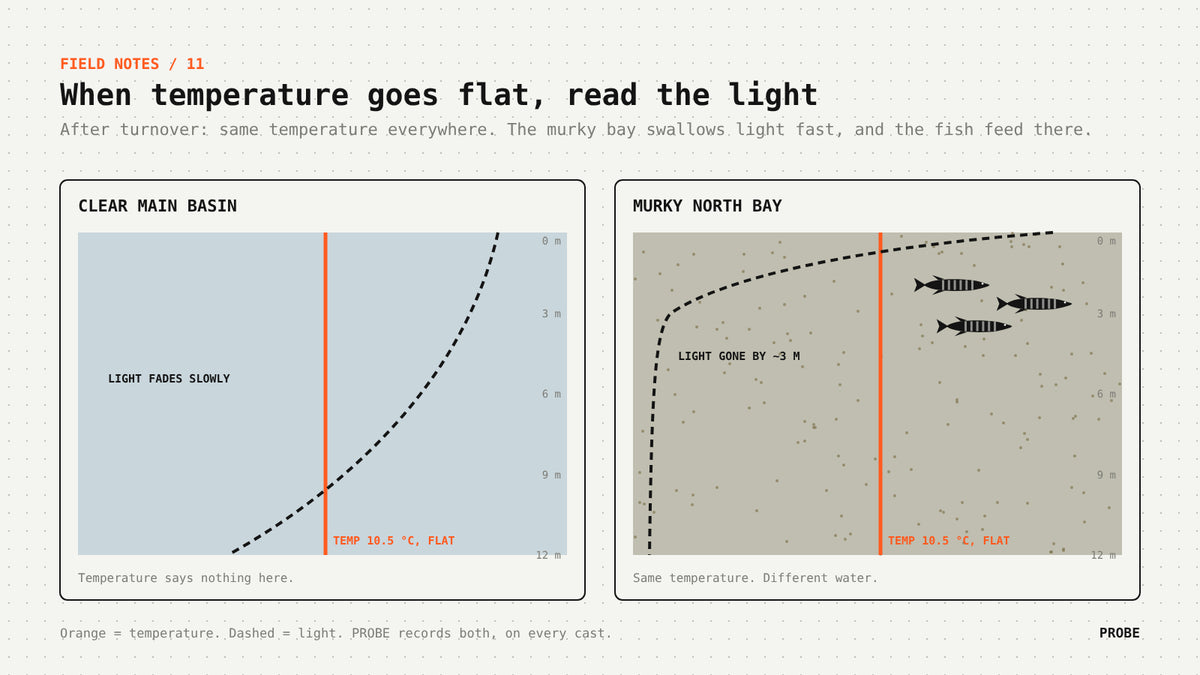
Signs often mentioned by anglers: water that suddenly looks murky or has debris floating, surface temperature around 10-13 °C (50s °F) and fish that seem to have vanished. The surest sign is a temperature profile. If the curve that had a sharp bend in August is now flat, the lake has turned.
With PROBE →
PROBE makes the most reliable sign easy to read. Every cast saves a temperature-vs-depth curve. Pull up last week's cast at the same spot and compare: a sharp bend that has gone flat means the lake has turned.
04
How to fish it
- Expect a few tough days during the mixing itself. Moving water such as rivers can be easier during turnover [6].
- Cover depths: one lure mid-column, one near the bottom [7].
- Look for bait first, then for the nearest structure to that bait.
- After turnover, the fall bite on big fish is often excellent.
See turnover happen on your own lake.
See how PROBE works →PROBE
How PROBE helps
PROBE gives you the temperature curve from the surface to wherever your lure goes, on every cast. Compare this week's curve with last week's in the app and you can see turnover happen on your own water. When the bend disappears, you know it is time to change tactics, search wider and look for the bait.
Field log /
Same lake, same spot, three dates through the fall turnover
| Sept 20 | 17 °C (63 °F) at the surface, sharp bend at about 7 m (23 ft) |
| Oct 4 | 13 °C (55 °F) at the surface, bend weaker and deeper, around 10 m (33 ft) |
| Oct 11 | about 10.5 °C (51 °F) from top to bottom, no bend: the lake has turned |
| Catch | Sept 20: 4 fish, all at about 6 m. Oct 4: 1 fish. Oct 11: 3 fish, spread from 2 to 8 m |
No bend in the curve means no layer holding the fish. That was the day to stop fishing one depth and search wider.
Field rule
No bend in the curve = no thermocline = fish can be anywhere. Search wider.
FAQ
Frequently asked questions
What is fall turnover?
As the surface cools in autumn it gets denser and sinks, the summer layers break down and the lake mixes from top to bottom.
Why is fishing bad during turnover?
Fish and bait scatter while the lake mixes. A few tough days are common; afterwards fish regroup.
How can I tell if my lake has turned?
Look at the temperature profile. If the sharp bend from summer is gone and the temperature is about the same from top to bottom, the lake has turned.
Turnover, measured. Not guessed.
Get PROBE →Sources
- Master Fishing Mag, "Fall Pike Blueprint"
- SMHI, "Temperatur i havet"
- In-Depth Outdoors forum, "Late Fall Muskie Trolling Locations"
- Fish Face Goods, "Casting for Muskies"
- Wired2Fish, "Fall Perch Fishing 101"
- Tennessee Musky Guide, "Musky Seasonality Guide"
- Bass Pro Shops, "Pete Maina: 10 Secrets to Trolling for Muskie"