
Field Notes / November 2026
The best tactics for trolling muskie: speed, depth and spread
At a glance
| fall speed | ~3.5 mph (Maina) |
| spread | one high, one low |
| lure size | big in fall, 8-10 in |
| colours | cisco silver / white |
Quick answer
Effective muskie trolling combines boat control, deliberate speed changes and turns to trigger strikes [1]. Cover water, run lures at known depths (one higher for suspended fish, one near bottom), adjust speed until you find what the fish want, and match the lure size and colour to the main forage.
The problem
Every trolling variable changes lure depth: speed, line out, line type, turns. You can control them all and still not know where your lures are. Without that, a strike is luck that's hard to repeat.
01
When trolling makes sense
Trolling shines when you need to cover a lot of water efficiently, for example on lakes with long, straight breaklines or big areas without obvious structure [2]. It is also the natural method for muskies suspended over open water in the fall [3].
02
Speed
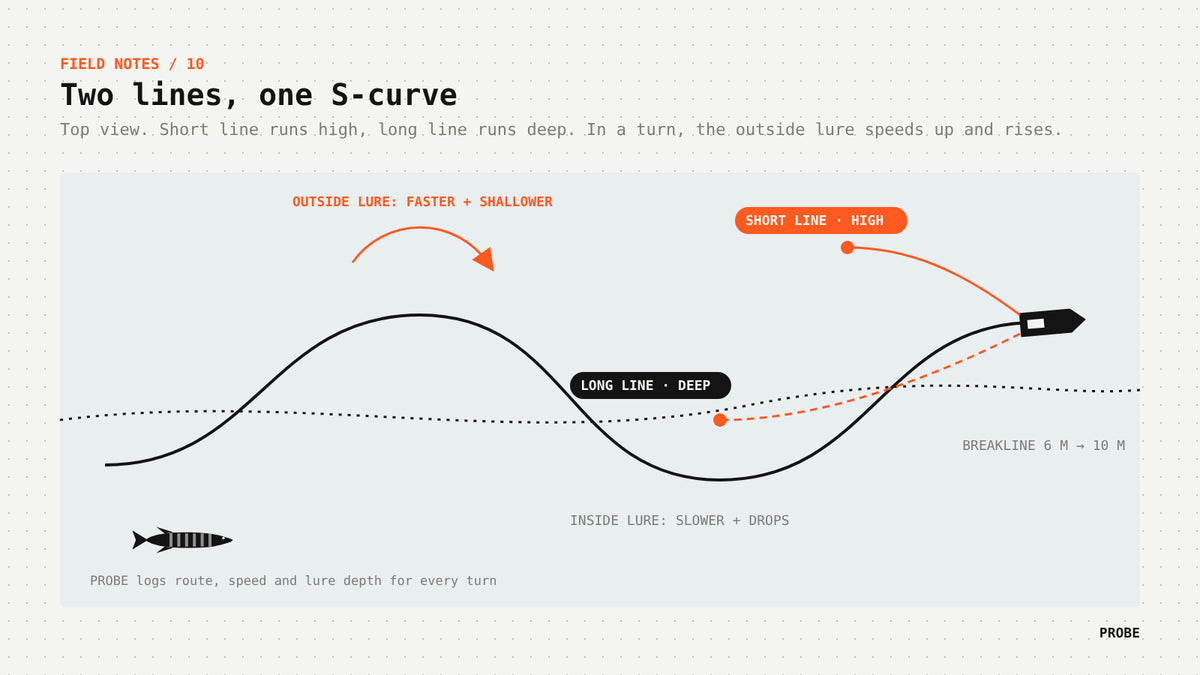
Pete Maina's average fall trolling speed is around 3.5 mph, slower in dirty water, and he notes that muskies can be patterned on lure speed [2]. Treat speed as a variable you test, not a fixed number. Adding swerves and S-curves to a trolling pass is one of the first ways to step up your game [4]; on a turn, the outside lure speeds up and the inside lure slows down, and that change alone can trigger a follower.
With PROBE →
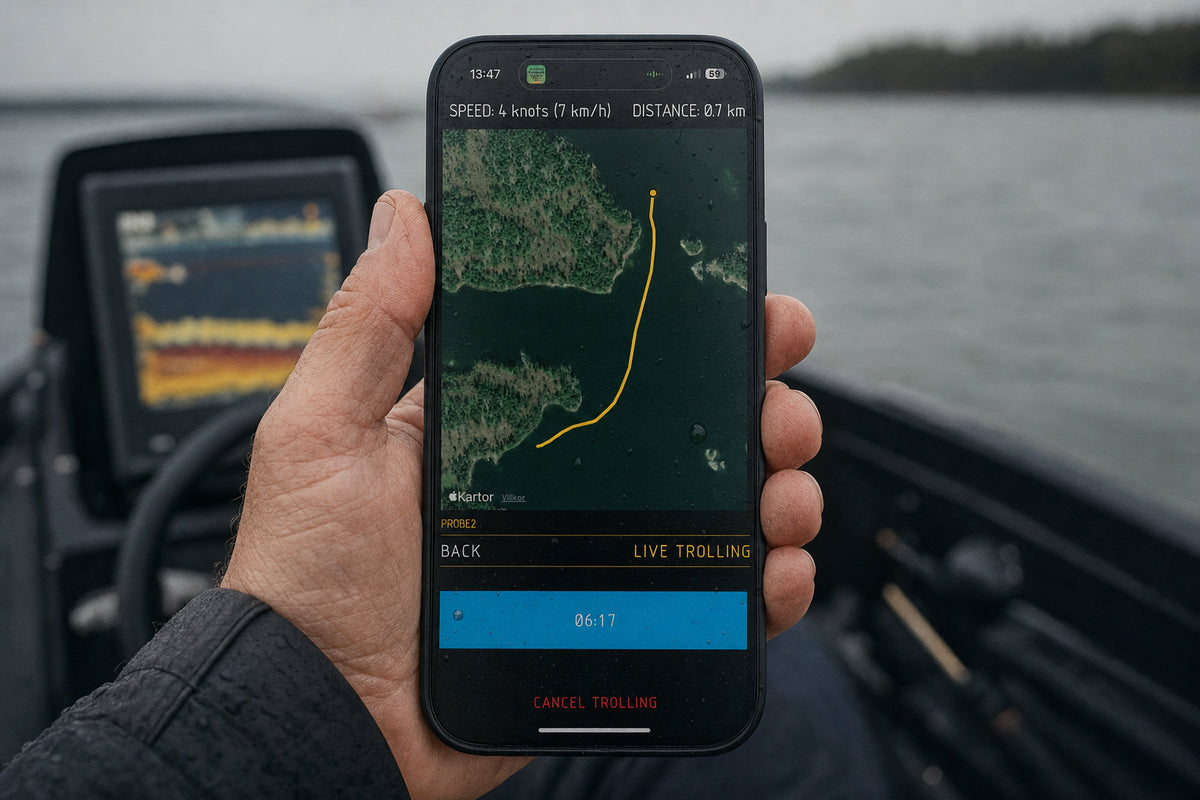
PROBE's trolling mode detects the session and records your route and speed. The app shows lure depth in relation to boat speed, so you can see how much your lure rises at 3.8 mph and drops at 3.0.
03
Depth and spread
- After turnover, run one lure about halfway down for suspended fish and one near the bottom [2].
- Over mud basins, run one lure about 2 ft off the bottom [2].
- Know your lure's running depth for your line and line length. If you are targeting an 8 ft area, choose lures that run 1-8 ft [4].
- If you mark fish at 30 ft, your lure must get at least close to that, preferably slightly above [5].
- Start a new area with lures at shallow to mid depth, then go deeper [4].
With PROBE →
Put PROBE on the line of each lure you want to know about. The app shows the real running depth of each one, so your spread actually covers the depths you planned: one high, one low.
04
Lures
Fall calls for bigger baits [2]. Classic trolling choices include large straight and jointed crankbaits and big rubber baits like Bull Dawgs [6]. Keep colour simple: silver/white in cisco lakes, gold where walleye are the main food [6]. Choose lures by size, running depth and colour, in that order [5].
Speed, route, depth: all in one trolling log.
See trolling mode →05
Boat control and gear
Muskie trolling rewards a system: each rod position has a job, some rods dedicated to the bottom, others to suspended fish [6]. Use reels with strong drags, because dragging big lures at depth puts real load on the gear [6]. Watch the sonar for sharp breaks and fish [2].
PROBE
How PROBE helps
Every variable in this article changes depth. PROBE's trolling mode records your route and speed and shows the lure's depth in relation to boat speed. When a fish hits, you get the strike depth and the speed you were doing, so you can repeat it on purpose instead of by luck.
Field log /
Mid-October, one crankbait on 36 m (120 ft) of line, testing speed
| Speed tested | 2.8, 3.3 and 3.8 mph (GPS) |
| Lure depth | 5.2 m at 2.8 mph, 4.6 m at 3.3 mph, 3.7 m at 3.8 mph |
| Turns | on S-curves the outside lure rose to about 3 m |
| Strike | 1 muskie on the outside line, mid-turn, at 3.6 mph and 3.4 m |
A one-mile-per-hour change in speed moved the lure 1.5 m. The strike came when the turn sped the lure up and lifted it.
Field rule
Log the speed of every strike. After five fish, you'll have a pattern. After ten, a system.
FAQ
Frequently asked questions
How fast should I troll for muskie in the fall?
Pete Maina averages around 3.5 mph in the fall, slower in dirty water. Treat speed as a variable and test it.
How should I set up my spread?
After turnover, run one lure about halfway down for suspended fish and one near the bottom.
Why do turns trigger strikes?
On a turn the outside lure speeds up and rises while the inside lure slows down, and that change can trigger a following fish.
Turn trolling strikes into a repeatable pattern.
Get PROBE →Sources