
Field Notes / October 2026
What depth are pike at in the fall?
At a glance
| early fall | similar to late summer, >16 °C |
| key trigger | baitfish move shallow |
| late fall | <10 °C, drop-off edges |
| best spots | deep weed edges, points |
Quick answer
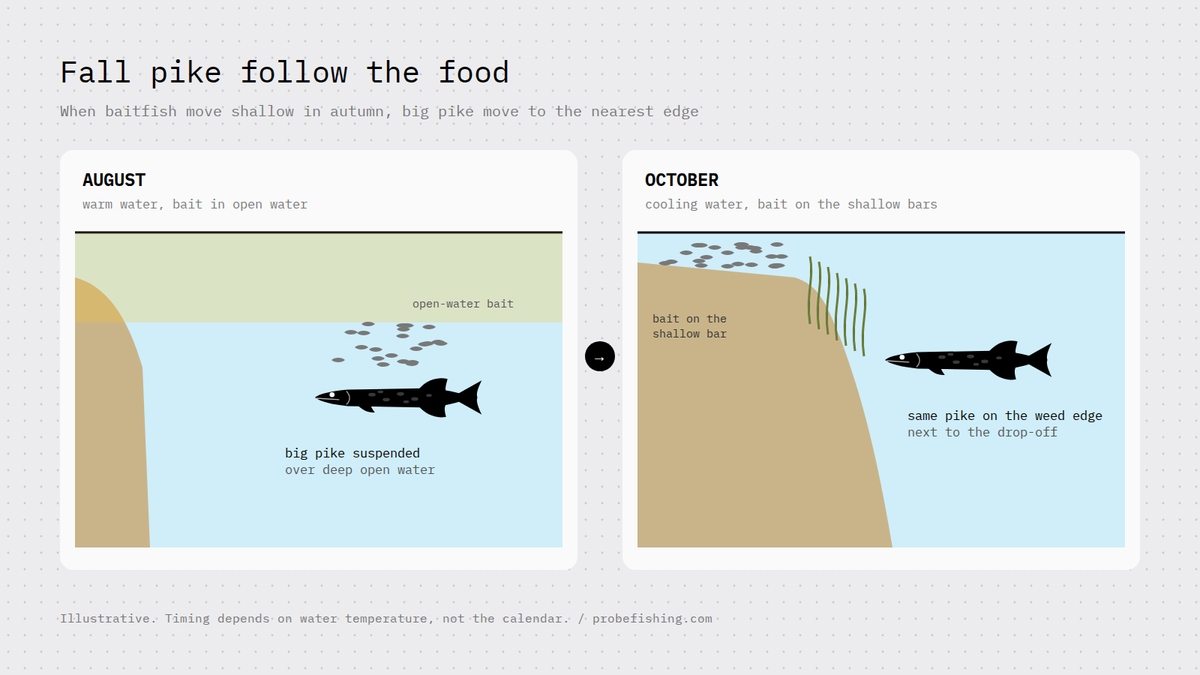
In early autumn, while the water is still above about 16 °C (60 °F), pike behave much like in late summer [1]. As it cools, the baitfish that big pike hunted over deep water in summer move shallow, and the pike follow [2]. Once the water drops below about 10 °C (50 °F), pike hold on the edges of drop-offs and the deepest, still-green weed beds, ambushing prey that moves past [3].
The problem
Every fall article tells you pike move "to the edges" and "deeper as it cools". None of them can tell you how cold your lake is today, whether it has turned over yet, or whether your lure is actually reaching the edge where the fish are. That is the gap between knowing the pattern and catching the fish.
01
Why fall is different
In summer, big pike often suspend over deep water, feeding on oily open-water baitfish. In autumn those baitfish move shallow to spawn, so to find big pike, find where the bait is spawning [2]. Pike that spent the summer in deeper basins come back toward the shallows [4]. The fish are more concentrated, and they are fattening up for winter.
02
Early fall: the summer hangover
Above roughly 16 °C, check inside weed edges, irregular pockets in the weeds and the first real depth change next to flats before moving to deep structure [1]. Early in autumn, big pike also follow spawning baitfish onto sand and gravel bars [3].
With PROBE →
Make three scout casts across a weed edge into deeper water. PROBE plots the temperature at each depth. If the surface is still above 16 °C and the curve still has a sharp bend, fish the inside weed edges and the first depth change. If the curve has gone flat, skip ahead to the late-fall pattern.
03
Turnover reshuffles everything
As the surface cools, it becomes denser and sinks, mixing the lake from top to bottom. This fall turnover brings oxygen back to deep water [5], and for a while fish can scatter (see Fall turnover explained: what happens to fish when the lake flips). After turnover, the focus moves to bigger, deeper main-lake weed beds that sit right next to deep water [4].
With PROBE →
You don't have to guess whether the lake has turned. Compare today's temperature curve with last week's in the app. When the bend disappears and the temperature is the same from top to bottom, turnover has happened, and it is time to move to the deeper main-lake weed beds next to deep water.
04
Late fall: edges and ambush points
Below about 10 °C, panfish and perch drift deeper, and pike wait for them on the edges of drop-offs and around the outer fringes of the deepest, healthiest weed [3]. Main-lake points, saddles and spots where weed meets rock are prime; work from shallow to deep and note the depth where you get bites, because pike often sit just off the break [6]. Rocks next to deep water and weed flats that meet deep basins are classic big-fish spots [7].
With PROBE →
Fall pike sit just off the break, so a lure that runs one metre too shallow swims over them all day. Cast past the edge and watch the depth trace in the app: you see exactly where your lure dropped along the slope. When a fish hits, the strike depth is saved. Next cast, put the lure at that depth again, on purpose.
Find the edge. Know the depth. Repeat the strike.
See how PROBE works →05
Slow down as it cools
Feeding windows get shorter in late autumn, but fish feed with intent [6]. As the water cools further, slow your presentation and consider bigger baits [8]. In Swedish waters such as the Stockholm archipelago and Lake Mälaren, autumn (September-November) is one of the two best periods for trolling pike [9].
PROBE
How PROBE helps
Fall pike fishing comes down to three numbers: how cold the water is at depth, how deep the edge is where the fish sit, and how deep your lure really runs along it. PROBE measures all three on every cast, 7 grams on your line above the leader, no screen to watch while you fish. Every strike is saved with depth, temperature, GPS position and weather, so by November you have your own fall pattern for your own water, not someone else's from a magazine.

Field log /
Mid-October, weedy bay with a drop-off to 7 m
| Surface temp | 10.8 °C |
| Temp at 5 m | 10.6 °C, curve flat: lake has turned |
| Casts logged | 62, 3 strikes |
| Strike depths | 4.6 m, 4.9 m, 5.1 m |
| Lure | jerkbait, braid 0.17 mm |
| Weather | overcast, falling pressure, SW wind |
All strikes came within half a metre of the same depth, just off the break. The shallow weed edge produced nothing all day. Next session: start at 4.5–5 m.

Field rule
Fall rule: find the bait, then find the nearest edge to deep water. That is where the big one is.
FAQ
Frequently asked questions
Are pike shallow or deep in the fall?
Both, depending on the stage. In early autumn they follow baitfish onto shallower bars and weed edges; below about 10 °C they hold on drop-off edges and deep weed.
Does turnover affect pike fishing?
Yes. During turnover fish can scatter for a while. Afterwards, focus on deeper main-lake weed beds and edges next to deep water.
What is the best lure depth for late-fall pike?
Just off the break. Work from shallow to deep and note the depth where you get bites, then keep your lure there.
Stop guessing where the edge is. PROBE shows lure depth, temperature at depth and strike depth on every cast.
Get PROBE →Sources
- Master Fishing Guide, "Fall Pike Fishing"
- The American Outdoorsman, "Northern Pike in the Fall"
- MeatEater, "How to Catch Trophy Pike in the Fall"
- Angling Edge, "Prime Time Fall Pike"
- Master Fishing Mag, "Fall Pike Blueprint"
- Explore Gear, "Fall Pike Fishing Playbook"
- Mercury Marine, "Year-Round Tactics for Northern Pike"
- The Fisherman, "Pre-Ice Pike: November Reign"
- Fishguide, "Trolling Fishing Guide Sweden"